American Mahjong Rules for Beginners: 152 Tiles, the Charleston & Winning Hands, Explained
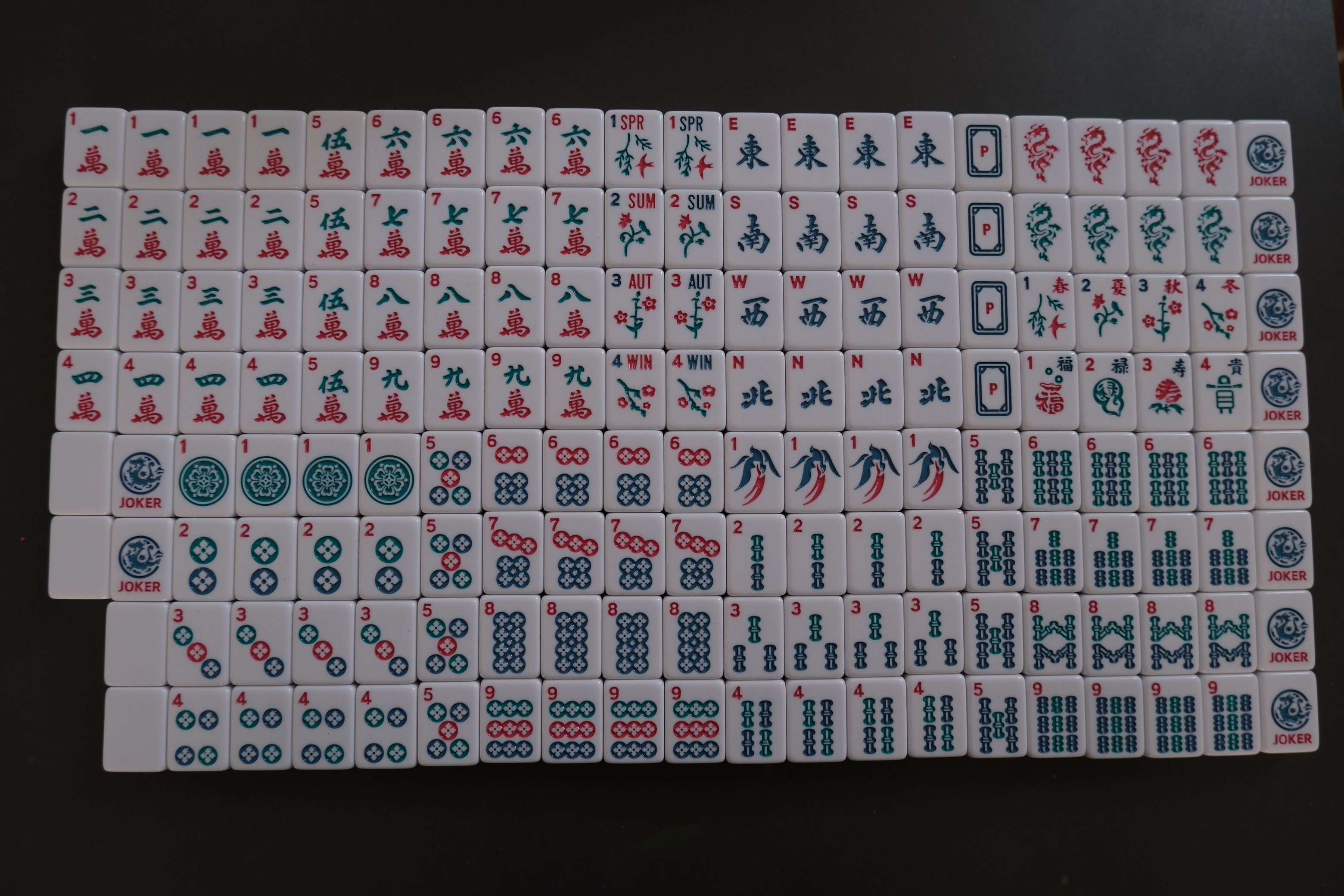
American mahjong has been played in the United States for nearly a century: four players, 152 tiles, a unique pre-game exchange called the Charleston, and a list of winning hands that changes every year. If you've just opened a set and the tile count doesn't match the 136 or 144 you're used to, this guide is for you. We'll cover three things: what's actually in the set, how a game flows, and the mistakes new players make most often.
American vs. Chinese mahjong: the three big differences
Mahjong reached the West from China in the 1920s, and American players went on to build an independent rules tradition of their own. Compared with Chinese-style play, three differences matter most:
- 152 tiles, not 144. The extra tiles are the 8 jokers (wild tiles) and the flower & season tiles numbered 1–8.
- The Charleston. Before play starts, players exchange tiles three times. No other regional version has this step.
- Winning hands come from the yearly card. American players don't build hands freely — they match a hand to an officially published card that updates every year.
The feel on the table is different too. The Charleston keeps things loud and chatty, and matching your hand to the card is closer to solving a puzzle than to the flow of a Chinese game.
What the 152 tiles actually are
This is the standard configuration, and it's the exact count we follow when we manufacture American sets:
| Group | Details | Count |
|---|---|---|
| Dots | 1–9, four of each | 36 |
| Bamboos | 1–9, four of each | 36 |
| Characters | Chinese numerals one to nine, four of each | 36 |
| Winds — East, South, West, North | 4 kinds × 4 | 16 |
| Dragons — Red, Green, White | 3 kinds × 4 | 12 |
| Flowers & Seasons | Two families numbered 1–8 | 8 |
| Jokers (wild tiles) | Stand in for any tile in a pung or kong | 8 |
| Total | 152 |
Two practical details. First, many packaged sets ship with spare tiles beyond the 152 — before you decide a set is "missing tiles", check the tile list printed on the box. Second, look for the red and blue numerals: on American tiles, the dots and bamboos carry red and blue numbers to match the color coding on the yearly card. If a set has no red-and-blue numerals, it wasn't made for American play.
The goal of the game
Four players each build a wall in front of them. The aim is to be the first to assemble a valid winning hand — exactly 14 tiles built from pungs (three of a kind), kongs (four of a kind), pairs, and sometimes single tiles, as defined by the yearly card.
Opening: the Charleston
Once the walls are built and each player holds 13 tiles, American mahjong's signature ritual begins:
- First pass — pass 3 tiles to the player on your right.
- Second pass — pass 3 tiles across the table to the player opposite you.
- Third pass — pass 3 tiles to the player on your left. There's a variation here called the blind pass: without looking at the faces, you can pass 1–3 tiles face down.
- Optional courtesy pass — if nobody declares a stop, players may agree to exchange another 0–3 tiles (to the left, across or right, as agreed).
The Charleston is why an American table is a lively one. Talking is allowed — telling the table "I'm collecting sevens" is perfectly legal, and part of the fun. And if your hand is already formed after two rounds, you can call the Charleston to a stop and move straight into play.
The playing phase
After the Charleston, play moves counterclockwise. On your turn you can draw, or claim a tile just discarded by another player:
- Draw — take a tile from the wall. If it completes a winning hand, declare "Mahjong!"; otherwise discard one tile.
- Claim — if a discard completes a pung, kong or pair you need, you can claim it out of turn. The completed set is exposed face-up in front of you (an exposure) and stays out of your hand for the rest of the hand.
- Jokers — a joker can replace any tile in a pung or kong, but it can never form a pair by itself. Once a joker is exposed, other players can even swap it for the natural tile they hold — a move unique to American play.
The first player to complete a valid 14-tile hand calls "Mahjong!" and wins the hand. Scoring follows the yearly card — every hand on the card carries its own point value. Four hands make a round, and the seat winds rotate between players.
Core terms at a glance
| Term | Meaning |
|---|---|
| Pung | Three identical tiles |
| Kong | Four identical tiles |
| Pair | Two identical tiles |
| Quint | Five identical tiles — only possible with jokers, and only for hands the card explicitly allows as quints |
| Exposure | A set claimed from a discard, laid face-up in front of you |
| Concealed | Keeping the whole hand hidden, never exposing a set — many card hands score more when concealed |
Three mistakes new players make
- Treating the Charleston as a formality. Beginners toss out any three "useless" tiles. In fact, the Charleston is prime hand-building time — pass toward the hand you're aiming for, not whatever is in front of you.
- Hoarding jokers. Beginners hold on to them "just in case". But the high-scoring hands on the card usually need kongs or even quints — a joker sitting in your hand is worth nothing until it reaches the table.
- Playing American rules with a Chinese set. A 144-tile Chinese set has no jokers and no numbered 1–8 flower/season tiles — it simply can't play the American game. Buy 152.
What to look for when you buy a set
Whether you're stocking a club, building a gift line, or launching your own brand, the gap between a good set and a "complaint collector" comes down to a few very concrete things:
- An honest tile count. A playable American set is 152 tiles — and many shipments add spares. The product page must say exactly which tiles are included; a vague count is the number-one source of disputes.
- Legible tile size. Larger tiles (38–40 mm tall) are easier on the eyes, especially when players compare against the yearly card all evening. Check all three dimensions — length, width and thickness — since thickness decides whether a tile fits a standard rack.
- The right material. The two mainstream materials have different personalities. Melamine is the workhorse: dense and solid in hand, impact-resistant, washable, and color-consistent at scale. Acrylic is the premium route: cast solid or layered, with sharp face detail and a translucent gloss that shines on club tables.
- Readable faces. Red-and-blue numerals, clean lines and a scratch-resistant finish — this is what players stare at for hours.
- Transport-proof storage. A rigid case with a formed insert keeps a set of about 3 kg from rattling loose on a long journey.
Looking for a supplier for American sets?
We build 152-tile American mahjong sets in Shenzhen for buyers worldwide — acrylic and melamine, 30–44 mm, full color range, multiple case options, with OEM customization. Trial from 100 sets; spec sheet and FOB quotation within one business day.
Request a Quote →