Custom Acrylic Mahjong Tiles: What's Possible, What Isn't, and Why
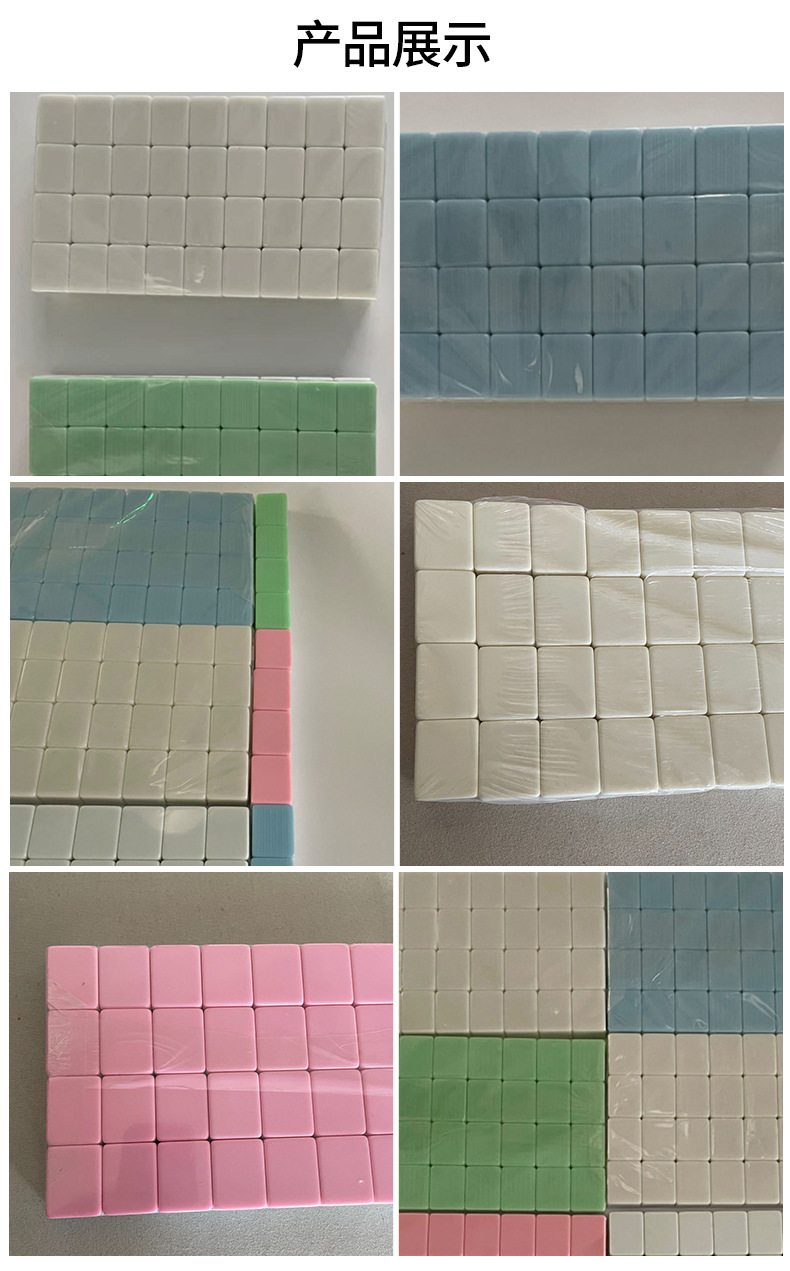
Almost every custom mahjong project starts the same way: a buyer sends a rendering they love and asks one question — "Can you make this?" The honest answer is rarely a clean yes or no. Solid cast acrylic is a material with a strong personality and very clear edges. Some ideas it executes better than any other material on earth; some ideas it physically cannot hold, and you will hear the same thing from every factory you ask. This article draws that line — because a supplier who tells you everything is possible is telling you they haven't checked.
In one paragraph. Solid cast acrylic reliably delivers four things: multi-layer lamination, laser engraving with spot-color fill, pearlescent back sheets, and roller-polished edges. It cannot deliver six things: a second color suspended inside a solid base (cobalt dots on ivory), photographic gradients cut by engraving, arbitrarily thin interlayers, ±0.1 mm tolerance on a laminated build, deep cuts without a thickness budget, or engraving on a pearlescent face. Every limit has a physical cause — and a neighbouring alternative that costs you one specific parameter.
Below: two comparison tables, six limits with their causes, the realistic path for each, and five questions that will get a supplier to answer in specifics instead of in adjectives.
Table 1: Request vs. feasibility, at a glance
If you read only one section, read this one. Everything after it is an expansion of this table.
| What you want | Possible? | Why |
|---|---|---|
| Multi-layer build — 2, 3 or 4 layers laminated, layers visible at the tile edge | Yes | Standard work. Every interface is a bond that has to be controlled — engineering, not a limitation. |
| Laser engraving + spot-color fill on the tile face | Yes | The recess sits below the wear plane, so the color is protected. Priced by the number of colors. |
| Pearlescent back sheet | Yes | A separate sheet category, laminated as a back layer. Pearl tones are limited — not Pantone-tunable. |
| Roller-polished edges, no step you can feel between layers | Yes | A post-cut process. This is exactly where cheap goods and good goods separate. |
| Flakes or a dot pattern inside a solid color — e.g. cobalt dots on ivory | No | Cast sheet color is fixed in the slurry: one sheet, one color. A second color cannot be scattered in at a controlled particle size and density. |
| Photo gradients, or thousands of colors, engraved on the face | No | Engraving is a spot-color process. Gradients and photographs belong to printing — a different wear class. |
| Wood, marble or stone looks | Depends on the sheet mill | Some mills cast patterned sheet. A mahjong factory cannot create this after the fact. |
| An interlayer thinner than 3 mm that still reads as a layer | No | Below roughly 3 mm the band collapses into a line at the tile edge instead of a layer. |
| ±0.1 mm dimensional tolerance on a laminated build | Practically no | Each layer is cut, ground and polished separately, and material loss varies slightly piece to piece. ±0.5 mm is the honest working value. |
| A deep groove in a thin back layer | Only to a point | Depth is capped by that layer's own thickness. Cut too deep and you break through into the layer behind it. |
The four things solid acrylic does best
Start with the strengths, because they are the reason this material commands a price at all.
1. Depth you can feel
An engraved and filled face is cut into the material, not printed onto it. The fill sits below the surface plane, so it does not wear away after years of play. Twenty-year-old tiles still read cleanly — the lines are still there, because the lines were never a coating.
2. Lamination you can see
In a four-layer build, the edge of every tile is a small cross-section of its own construction. That visible stack is the signature of the category — and something printing can never imitate.
3. Weight and sound
A 36 × 25 mm tile at roughly 15 mm overall thickness lands between 19 and 21 g, depending on the layer build. That mass is where the crisp tile-on-tile click comes from; players hear it and know immediately whether they are holding a real set.
4. A surface that catches light
A pearlescent back shifts color as the tile turns. That property belongs to the sheet itself, not to a coating — which is why it survives wear.
Six things it cannot do — and why
These are the six "impossible" requests we are asked about most. For each one, the physical cause comes first, then whether a nearby path exists. A limit with a cause is a trustworthy limit; a "we can't" with no cause usually just means the supplier would rather not.
1. It cannot suspend a second color inside a solid base
This is the most common request, and it usually arrives as a rendering showing fine speckles, a terrazzo effect, or a "confetti" interlayer. Cast acrylic color is decided at the slurry stage: pigment goes into the resin before the sheet exists, and the result is one sheet, one color. No process lets a sheet mill disperse cobalt particles at a controlled grain size and density into an ivory base.
Some effects that look similar do exist — and they are worth knowing by name, so you can ask precisely:
- Metallic glitter sheet (often called glitter acrylic) — reflective flakes suspended in the sheet. In the hand it reads as a speckled interlayer and it catches light beautifully. But the flakes are reflective, not pigmented; the pattern is random; and grain size and density are set by the sheet mill — not by you, and not by us.
- Patterned cast sheet — some mills cast marble, wood or stone looks. Availability depends on region and thickness, and it is a material you buy, not an effect you specify.
- A printed interlayer — a printed film sandwiched between two acrylic layers. This is the only route that reproduces hand-drawn multi-color speckles precisely. It also has a real weakness: the lamination line and the cut edge are exactly where this construction shows its limits — and the edge is the one place a mahjong tile cannot afford to fail.
One distinction has to be made explicit here: "looks close in the hand" and "matches the rendering exactly" are two different promises, at two different prices, with two different risk profiles. Ask any supplier which of the two they are quoting you.
2. It cannot engrave a photograph
Engraving is a spot-color process: one color, one operation — cut first, fill after. That makes it excellent for line art, standard type, traditional tile faces and flat brand colors, and completely unsuited to gradients, photographs and thousands of tones. Those belong to UV printing, where ink is applied and cured under ultraviolet light. UV printing carries no per-color cost, but the ink sits above the wear plane — and that is the first thing to come off a heavily used set.
Neither route is "better." Choosing the wrong route for your artwork is the genuinely expensive mistake.
3. It cannot give you an arbitrary interlayer thickness
Multi-layer designs often want a thin, bright band between two thick faces. There is a floor to how thin that band can be and still hold its shape.
Below roughly 3 mm, the band stops being a layer at the tile edge: it collapses into a line between the two faces, and the effect you paid for disappears — money spent, nothing visible. At 3 mm it still reads as a band, but a tight one, with no margin to hide the lamination line.
And the interlayer is not a free variable, because it goes straight into the thickness budget:
The arithmetic: interlayer (minimum 3 mm) + face layer + back layer = finished tile thickness. If the interlayer must be 3 mm and the tile must stay thin, the two faces are what give. If both faces must stay thick, the tile gets thicker — and may no longer fit a standard rack slot. Before you design around the interlayer, decide which of those three numbers cannot move.
4. It cannot hold ±0.1 mm on a laminated build
This number causes more friction in this category than any other figure, so it is worth stating plainly. In a multi-layer build, every layer is cut, ground and polished separately, then laminated. Material loss varies slightly from piece to piece. The industry-wide working tolerance is ±0.5 mm — an honest number, not a marketing one.
Tighter tolerance is achievable on a solid one-piece construction, where there is no interface and no lamination. On a laminated build it can occasionally be achieved too — but only if the factory has already tested your actual requirement against your actual geometry.
What matters more than the number is its practical consequence. If you are also specifying a tight-slot rack, a ±0.5 mm tile in a ±0.2 mm slot produces goods that "sit fine on the table and jam in the box." Write both tolerances down together, and require a physical fit test before mass production — not after.
5. It cannot cut deep without a thickness budget
Grooving a back, or carving deep relief into a face, is limited by the thickness of the layer you are cutting. On a multi-layer tile, the back is one layer among several, and its thickness is already fixed by the arithmetic above. Cut too deep and you break through into the layer behind it — the groove is no longer a groove, it becomes a window onto whatever lies beneath. That is a different design.
There is a second cost. A deep cut concentrates stress, and acrylic moves. On a tile that must sit flat on a table and stack square, that shows up as warp and wobble rather than as a visible defect.
The usable answer always has the same shape: tell the factory your total thickness and how deeply the pattern needs to feel, then ask how much depth that specific layer can actually take.
6. It cannot engrave a pearlescent back without destroying it
The value of a pearl back sheet is that it is continuous. Cutting into it interrupts that soft light rather than adding to it — you end up with a matte scar in the middle of the effect. If the back needs decoration, printing a layer onto it is the better route; otherwise leave the back clean and let the material speak.
Table 2: What you want, the realistic path, and what it costs you
Most "impossible" requests have a genuinely good alternative sitting next to them. What matters is that nobody pretends the alternative is the original.
| What you want | The realistic path | What you give up |
|---|---|---|
| Speckled interlayer inside a solid color | Use a metallic glitter sheet as the middle layer | Exact flake color, grain size and density |
| Exactly reproduced hand-drawn multi-color speckles | Two acrylic layers with a printed interlayer | Edge quality, and whether the lamination line is visible — the two things a mahjong tile is judged on |
| Photo-grade or gradient tile faces | UV printing on a solid or laminated build | Long-term wear resistance |
| A thin, bright interlayer | Take the interlayer to the 3 mm floor and adjust both faces | Overall thinness, or face thickness |
| A deep groove in the back | Thicken the back layer and take the extra from elsewhere | Overall dimensions, rack fit, weight |
| Three or four pearlescent back colors | Use opaque solid back sheets for accurate color | The soft shimmer of pearl |
How to ask, so you get a straight answer
Suppliers default to "yes," because "yes" ends the conversation and "no" invites questions. To get something far more useful, shape your questions so that a specific answer is the only possible reply. Five steps, in this order:
- Send the rendering together with the physical constraints. A picture alone tells the factory what shape you want. Total thickness, tile dimensions and rack slot width tell them whether you can have it.
- Name the number that cannot move. Interlayer thickness, overall thickness, face thickness — which one is non-negotiable? In any set of three, one usually has to give.
- Ask about the process, not just the answer. "Can you do speckles?" earns a "yes." "Which process gives me speckles, and what does it cost me at the edge?" earns the truth.
- Ask what the tolerance is measured on. ±0.5 mm on which dimension, measured how, across how many pieces? The answer separates a number that was measured from a number that was memorized.
- Require samples before mass production. A handful of representative physical tiles settles more than any spec sheet — and a factory that can genuinely make your design will want you to see them.
Have a design but aren't sure it can be made?
Send the rendering with the total thickness, the tile dimensions and your rack slot width. We will tell you which parts are straightforward, which need another route, and which simply cannot be done in solid acrylic — before you commit to tooling costs, not after. Lonyard produces custom acrylic and melamine mahjong for brands and buyers in the US, Europe, the Middle East and Southeast Asia.
Send Your Design →Specification note. The ±0.5 mm tolerance, the 3 mm interlayer floor, the 19–21 g weight and the 36 × 25 × 15 mm dimensions quoted here are factory-confirmed in writing. Every "cannot" in this article refers to the physical limits of solid cast acrylic sheet as a material; it does not mean that no alternative material or process exists in the industry.